LLMs1 min read
llm-anthropic 0.28: Claude Fable 5.1 and New Features
llm-anthropic 0.28 introduces Claude Fable 5.1 with default reasoning traces and a new exception for refusals.
From Simon Willison
Blog
Daily notes on new models, LLM releases, agent frameworks and AI research, written from the sources we follow and delivered as a newsletter every day.
Get the daily issue
Every new post of the day, in one email. Confirmation required.
LLMs1 min read
llm-anthropic 0.28 introduces Claude Fable 5.1 with default reasoning traces and a new exception for refusals.
From Simon Willison
LLMs1 min read
Meta's Muse Glimmer is a 30-billion parameter open-weight dense model with a 120K+ context window, designed for local AI applications and open source deployment.
From NVIDIA technical blog
How this blog is made
Each feed entry becomes one request to OpenSmartRoute: the router picks a model with a cost-weighted objective, the editorial-writer skill is layered on the prompt, and the outcome trains the learners - the same pipeline available to every workspace.
Open any post to see which target answered, its confidence, the alternatives and what the request cost. Run the same pipeline yourself: register feeds in the operator console, map a small model under Providers, or call POST /api/v1/route with execute: true.
The OpenAI Codex desktop app stores LibreOffice binaries in its cache, including full installations and usage skills, which may impact model deployment and integration strategies.
From Simon Willison
LLMs1 min read
NVIDIA ALCHEMI Toolkit utilizes AI coding agents to streamline atomistic simulation workflows, combining scientific knowledge with compute-efficient implementation. This enables faster, more accessible materials research by providing accessible interfaces for simulation.
From NVIDIA technical blog
Agents1 min read
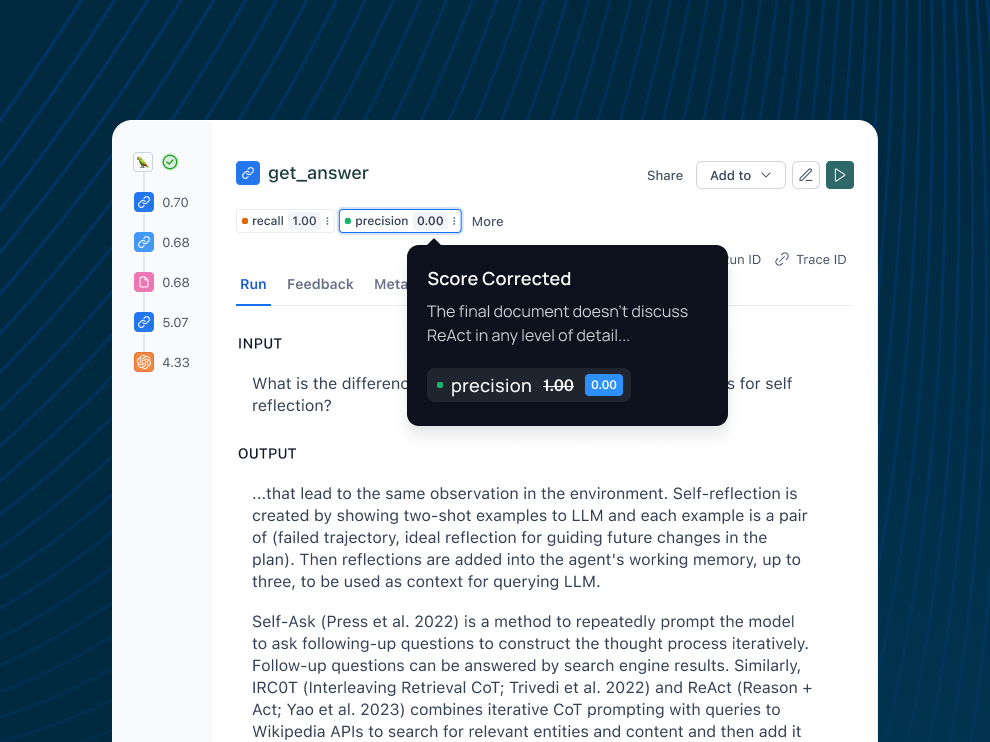
LangSmith’s new LLM-as-a-Judge evaluators incorporate self-improvement through stored human corrections, reducing prompt engineering and enabling adaptive alignment with user preferences. This streamlines evaluation for generative LLM applications.
From LangChain blog
Agents1 min read
Factory, a provider of AI-powered SDLC automation, utilized LangSmith to automate its feedback loop, achieving a 2x improvement in iteration speed. The self-hosted platform enabled robust observability and data privacy for complex LLM workflows.
From LangChain blog
LLMs1 min read
NVIDIA Dynamo introduces Shadow Engine Recovery, allowing LLM inference engine processes to recover in seconds instead of minutes. This reduces downtime and improves operational efficiency for production deployments.
From NVIDIA technical blog
LLMs1 min read
A new 4-bit model, dubbed Quantization-Aware Healing, achieves performance comparable to its full-precision original. This technique offers a compressed model size with minimal impact on accuracy for running AI agents.
From Hugging Face blog
LLMs1 min read
Alibaba has released the open weights for Qwen3.8-2.4T-A95B, a 2.4 trillion parameter model, allowing near-frontier capabilities to be deployed on NVIDIA GB300 NVL72 systems. This enables engineers to run large language models with configurable reasoning.
From NVIDIA technical blog
LLMs1 min read
IBM Research has released ALTK Evolve, a hierarchical multi-modal agent system. The system utilizes a 7B parameter model and demonstrates efficient operation with 8GB of memory.
From Hugging Face blog
LLMs1 min read
This report details the evolving state of open models, focusing on size trends, licensing options, and key performance indicators for models deployed in production environments. It highlights shifts in model architecture and accessibility for engineers.
From Hugging Face blog
LLMs1 min read
Hugging Face introduces Strands Agents and LeRobot, enabling continuous data streaming for model training and deployment. This allows for real-time data processing and model updates, improving efficiency and responsiveness in production environments.
From Hugging Face blog
LLMs1 min read
IBM Research has developed ALTK Evolve, a system that achieves comparable performance to models like ACE while utilizing significantly fewer tokens. This reduces operational costs and improves inference speed for agent-based applications.
From Hugging Face blog
Research1 min read
Flint is an open-source visualization language enabling AI agents to generate expressive charts from concise specifications. It provides a middle ground between simple chart specifications and complex manual chart creation.
From Microsoft Research
Posts are drafted from public feeds by models OpenSmartRoute routes to - the same router, skill and metering customers use - and always link to the original source. Corrections: support.