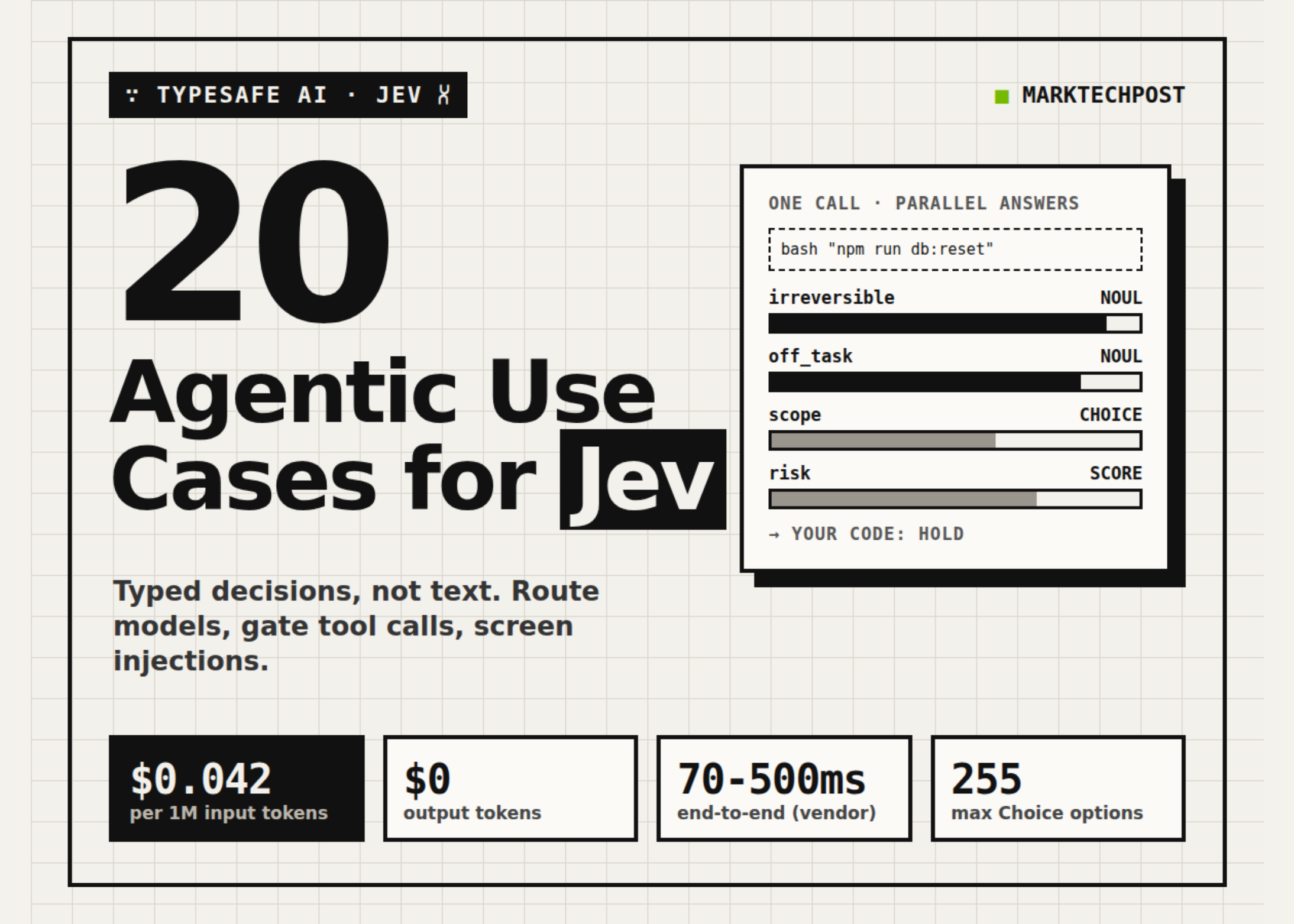
TypeSafe AI launched Jev, a new model designed for decision-making tasks. Unlike chat or code models, Jev provides typed answers with probabilities. It is built for small judgments inside agent loops, such as model routing, safety checks, and relevance decisions.
Jev uses three main primitives: Choice, which picks options with probabilities; Score, which rates states; and Noul, which checks if a statement is true. All questions are evaluated in parallel in one request. Jev is trained with Reinforcement Learning for Calibrated Decisions (RLCD), so higher confidence should mean higher accuracy.
TypeSafe claims Jev is 193.6 times faster and 444.6 times cheaper than previous workflows. It uses GPT-6 Astra and Fable 5.1 as reference models. Jev can support up to 255 options for Choice questions, making it flexible for various decision tasks.
Jev is used for model routing, skill selection, function calling, ticket triage, risk gating, auto-approval, secret leak detection, prompt screening, reranking, citation verification, and more. It is capable of fast responses, such as browsing in about 7 seconds or classifying actions on mobile in about 21 seconds.
For example, Jev scored 81% on a legal query test, slightly below a large language model, but at a fraction of the cost and speed. It is not a replacement for large models but works alongside them to handle bounded decisions efficiently.
Why it matters
Speed and cost reductions enable more efficient and scalable AI agent systems.
What to do
Evaluate Jev for decision tasks in your AI workflows. Calibrate thresholds to match your traffic and safety needs.
Source: https://www.marktechpost.com/2026/09/27/20-agentic-use-cases-of-typesafe-ais-jev/