Dynamic Model Orchestration for Coding Tasks
GitHub has announced Project HydraFusion, a research preview designed to improve the quality and efficiency of coding tasks by dynamically orchestrating multiple models. This system operates at runtime, selecting the most appropriate workflow based on the specific task requirements, balancing performance, cost, and latency. The goal is to provide developers with access to frontier-level intelligence without requiring manual model selection or complex configuration.
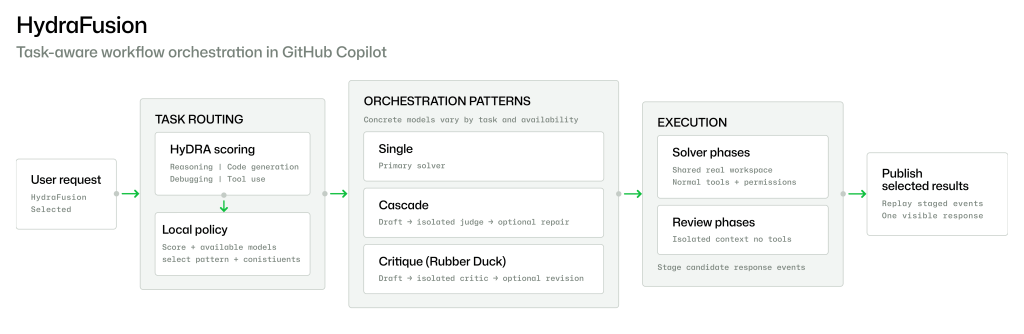
HydraFusion employs a sophisticated approach, utilizing three primary execution patterns: Single, Cascade, and Critique. The ‘Single’ pattern directly utilizes a single model for the task. The ‘Cascade’ pattern involves a draft from an efficient model followed by a quality gate, escalating to a stronger model if needed. The ‘Critique’ pattern employs an independent review model to assess the draft, followed by revision by the original drafting model. Each pattern is optimized for different quality-to-cost trade-offs, allowing HydraFusion to adapt to the specific needs of each coding task.
During offline evaluations, HydraFusion consistently demonstrated frontier-level quality across three agentic coding benchmarks: TerminalBench 2.1, DeepSWE, and CheckpointBench. When compared to Claude Opus 5, HydraFusion achieved a 4.9 percentage point improvement in verified task quality while reducing estimated costs by 67% on TerminalBench 2.1. These results highlight the potential for significant cost savings and improved performance through intelligent model orchestration.
Underlying this performance are five key operating principles. These include complete accounting for all workflow legs, bounded execution to manage costs and latency, isolated review to ensure independent assessments, fail-safe application to prevent incomplete changes, and validated routing to verify workflow definitions. The system internally records detailed metrics about each execution leg, providing a comprehensive understanding of the workflow’s performance. This data is then presented to the developer as a coherent response and a permission-aware change set, simplifying the development process.
GitHub plans to continuously refine HydraFusion by incorporating new models from the GitHub Copilot ecosystem. The system's adaptive nature allows it to leverage the strengths of available models, ensuring it remains at the forefront of intelligence. Ongoing research will focus on validating these findings in real-world developer workloads and further optimizing HydraFusion for production quality, latency, reliability, caching efficiency, cost, and safety.