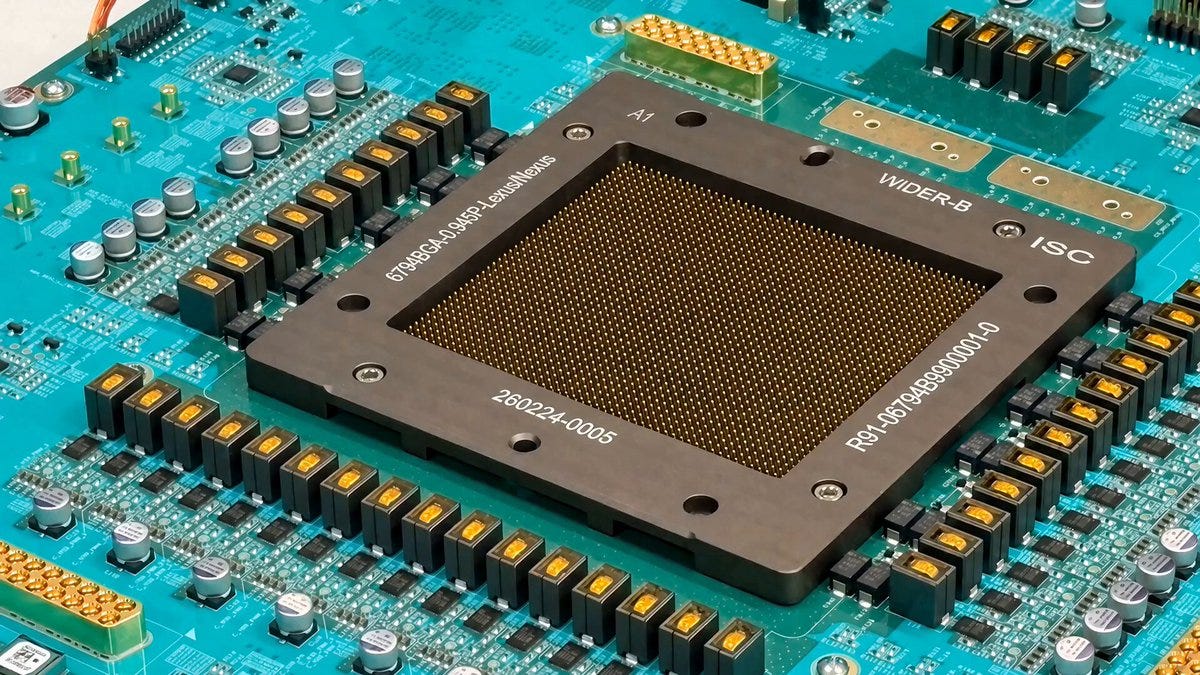
OpenAI’s Jalapeño inference chip represents a significant advancement in inference hardware. Initial benchmarks show a 1.5–1.9x increase in work per watt at peak throughput and a 1.7–3.6x reduction in end-to-end latency compared to NVIDIA GB200/GB300 systems on real model workloads. The chip is rated at 700W but reportedly operated at or below 550W during testing. This performance advantage is particularly notable because Jalapeño achieves it without relying on techniques like aggressive prefill/decode disaggregation or speculative decoding, even when systems utilizing these techniques were employed.
Beyond raw performance, Jalapeño’s architecture appears to offer a more balanced approach to inference, addressing the traditional trade-off between throughput and latency. OpenAI’s post highlighted the role of GPT-Astra + Codex in optimizing low-level kernels, enabling three previously unplanned open-weight models to achieve high performance on Jalapeño within approximately two months. This suggests a growing trend of integrating compiler and kernel work directly into the model improvement process, moving beyond solely application-layer coding.
Furthermore, Jalapeño’s capabilities have implications for broader industry trends. Several analyses suggest that frontier labs may no longer be solely reliant on NVIDIA for inference economics, even if packaging and foundry capacity remain a constraint. This shift is fueled by Jalapeño’s competitive performance.
Concurrent developments are also reshaping the agent ecosystem. Microsoft’s AutoSaddler approach treats the harness as code, patching prompts and tool configurations offline. This resulted in gains of +9.0, +9.6, and +10.0 on GAIA2, SWE-Bench Pro, and Terminal-Bench 2.0, respectively. Another study quantified harness variance, revealing that swapping harnesses could significantly alter model rankings, necessitating a structured Harness Card disclosure standard.
Finally, research into memory systems is evolving, with Alibaba’s work backing agent sessions with an append-only event log and a persistent Python kernel. This approach achieved 94.8% on LongMemEval_S and 73.1% on BEAM_10M, demonstrating the potential of programmable state for agent sessions. Source: https://www.latent.space/p/ainews-hot-chips-openais-jalapeño