Search systems often return only one result. They now need many different options for a single query.
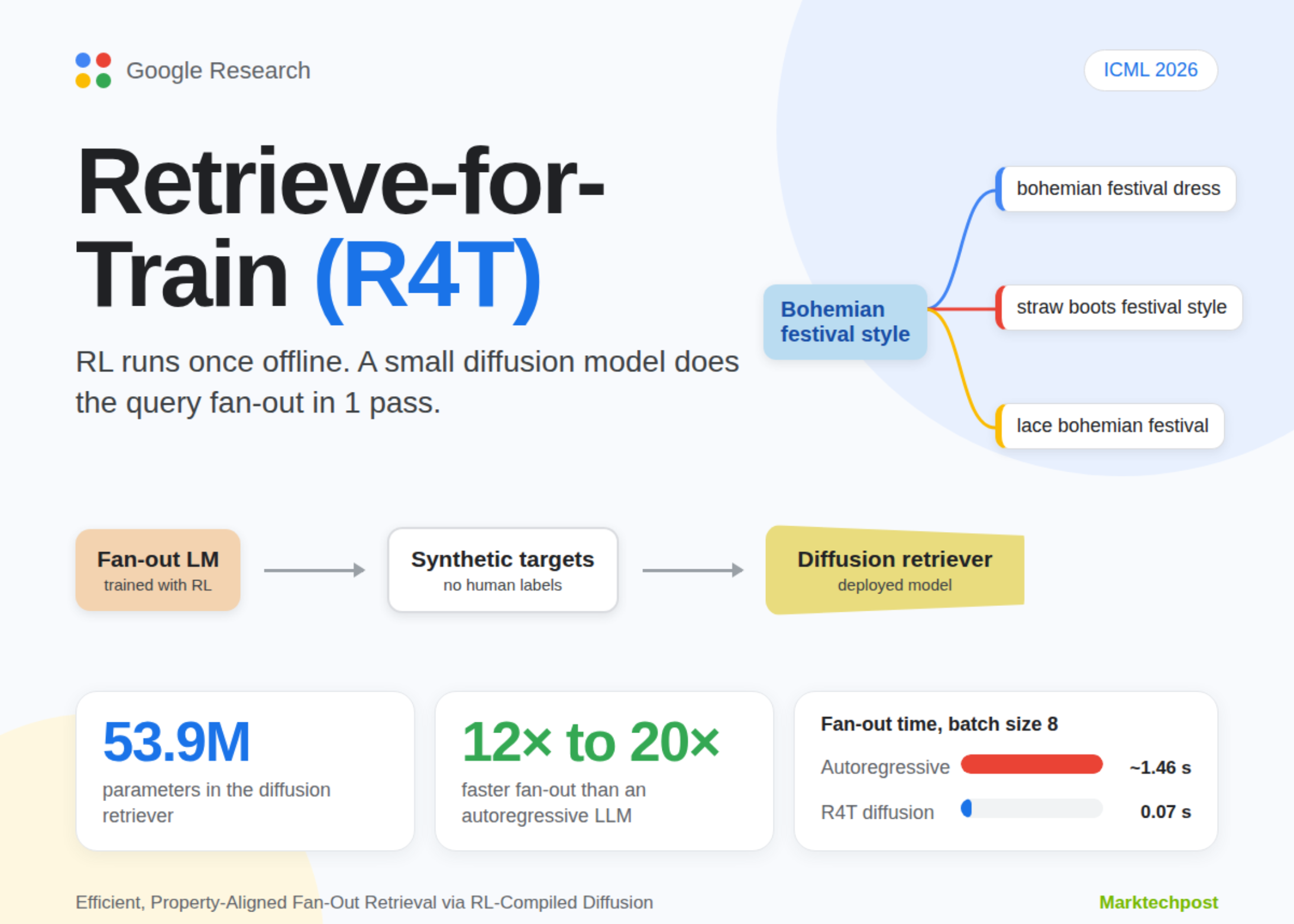
Google Research introduced Retrieve-for-Train (R4T). It uses reinforcement learning once to learn how to split queries into multiple directions.
A small diffusion model then produces all retrieval directions in a single pass. This avoids the slow step-by-step generation of standard language models.
How It Works
The system generates sub-queries, runs them through a frozen retriever, and scores the whole set. It trains on synthetic data without human labels.
A 53.9 million parameter diffusion transformer maps queries to result sets. It uses a variance-exploding formulation within the EDM framework.
Why it matters
Standard methods suffer from paraphrastic collapse or high latency. R4T blocks these issues with three specific reward terms: groundedness, diversity, and alignment.
Experiments show significant speed improvements. Autoregressive fan-out took 1.46 seconds at batch size 8. The diffusion model completed the same task in 0.07 seconds.
At larger batches, the difference grows wider. Autoregressive methods reached nearly 50 seconds. R4T finished in just over 4 seconds.
This represents a consistent 12x to 20x speedup. It also improved quality scores on fashion and music datasets compared to previous methods.