Understanding the Generative AI Customization Spectrum
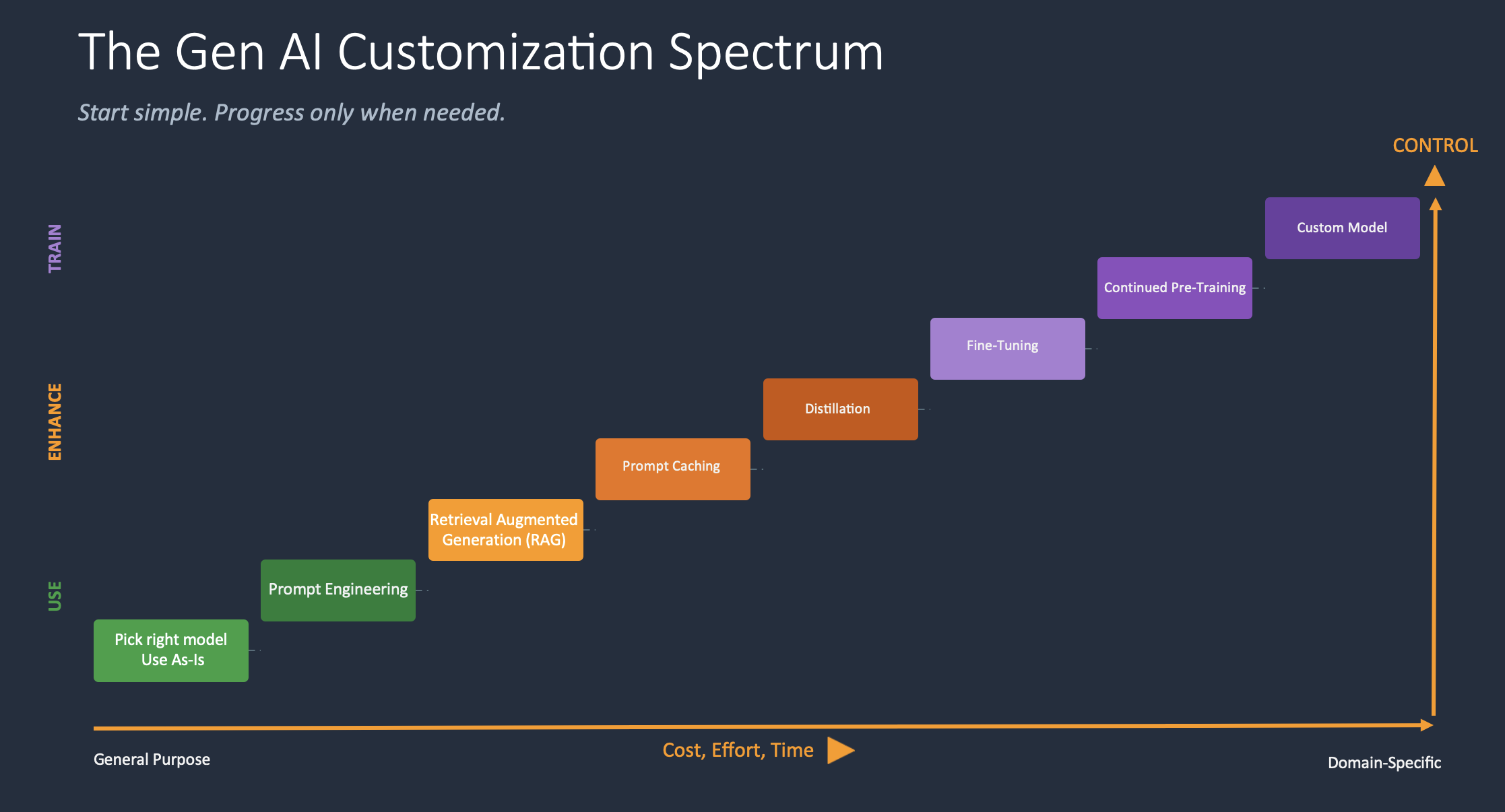
AWS presents a spectrum of approaches for utilizing generative AI models, offering options from basic prompt engineering to full model retraining. This spectrum provides a structured approach to selecting the right customization strategy, preventing over-engineering or under-investment. The core principle is to start with the simplest approach and escalate only when necessary.
The spectrum is divided into three categories: USE, ENHANCE, and TRAIN, each representing an increasing level of complexity and investment. Starting with ‘USE’ involves directly calling foundation models like Claude, Amazon Nova, or Llama through Amazon Bedrock without any modifications. This is suitable for general-purpose tasks where off-the-shelf accuracy is sufficient. ‘ENHANCE’ builds upon this by incorporating techniques like Retrieval Augmented Generation (RAG) or caching prompts, while keeping the model weights frozen. Finally, ‘TRAIN’ involves updating the model’s weights through fine-tuning, continued pre-training, or building a completely custom model using Amazon Nova Forge.
Key Steps and Escalation Signals
The framework defines eight steps, progressing from basic usage to advanced model training. Each step has a specific purpose, associated AWS services (Bedrock, SageMaker, Nova Forge), and clear escalation signals. For example, Step 1 involves using existing models as-is, while Step 8 involves training a fully custom model. The escalation signals indicate when a step has failed to meet accuracy, latency, or domain requirements, prompting a move to the next level.
Cost and Data Considerations
The chef analogy illustrates the cost and investment associated with each step. Simple prompt adjustments are inexpensive, while extensive model training represents a significant investment. The distillation technique, exemplified by teaching a line cook the bestsellers, demonstrates a cost-effective approach to replicating a model’s knowledge for specific tasks. The framework emphasizes starting with the simplest approach and only escalating when necessary, considering data requirements and potential costs.