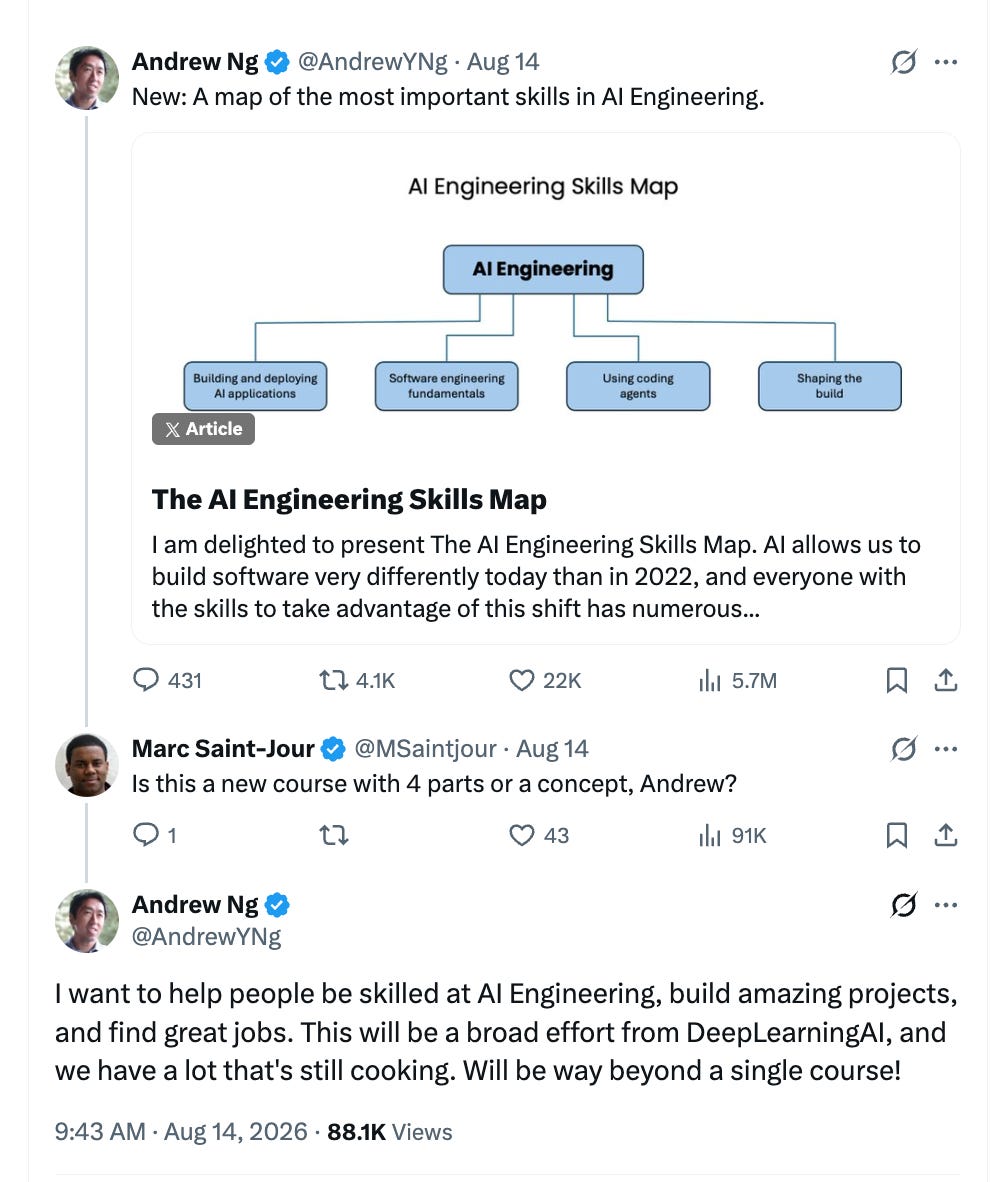
Andrew Ng’s relaunch of DeepLearning.ai with a focus on AI Engineering follows an extensive investigation of the field. The analysis, encompassing over 10,000 job postings, dozens of interviews, and extensive data gathering, identified four core skills. These include the ability to build and deploy AI applications, leveraging LLMs, RAG, and agentic workflows, alongside a strong foundation in software engineering principles. Crucially, the analysis highlights the growing importance of using coding agents effectively, emphasizing the need for developers to understand their limitations and how to steer them for robust software development.
The report notes a significant shift in the AI landscape, driven by advancements in coding agents. The rise of tools like Cursor and Claude Code, alongside Cognition and Cline, demonstrates a move beyond traditional ‘C’ based models. This agility is recognized as a key advantage, alongside a cautious approach to models prone to ‘tokenmaxxing’ and LLM psychosis. Furthermore, the report emphasizes the need for product sense and business context, advocating for engineers to actively participate in shaping AI projects, including the decision to build MVPs for user testing or to prioritize careful, deliberate development.
Recent research further illuminates the importance of agent harnesses. NVIDIA’s work demonstrates that traditional agent evaluation metrics, such as scan scores, offer limited predictive power, correlating with judged quality at a Spearman ρ of 0.14. Instead, measuring ‘Skill Lift’ – the difference in performance with and without a specific skill – provides a more accurate assessment. Simultaneously, a position paper advocates for enterprise standardization on reusable coding agent harnesses, arguing that harness choice can be more impactful than model selection.
Open-source implementations like Headlong, introduced by @andykonwinski, are contributing to the advancement of persistent agents. This ‘microharness’ utilizes a DAG of jsonl files for trajectory storage, a self-guided inner loop, and reportedly achieved unattended self-debugging repair in 48 minutes. The system has a background thinking cost of $1–$2/hr and occasional self-inflicted failures. These developments underscore the increasing sophistication and practicality of agent-based systems.
Source: https://www.latent.space/p/ainews-andrew-ng-gets-into-ai-engineering