Hi - I answer from the OpenSmartRoute documentation: routing, the API, plans and quotas, self-hosting. Ask away, or open a support ticket if you need a person.
Grounded in the docs - follow a source before acting on it.
Amazon doubles robotic arms and adds touch sensors to warehouses - OpenSmartRoute
Amazon doubles robotic arms and adds touch sensors to warehouses
Amazon plans to double its robotic arm fleet this year while introducing Vulcan arms with touch sensors. The company uses AI to improve picking success rates and manage robot traffic in warehouses.
Key points
Amazon expects to more than double its robotic arm fleet this year.
The new Vulcan arm combines vision with force feedback touch sensors.
AI improved robotic picking success rates to 93.73 percent in trials.
Amazon Robotics manufactures robots in-house in Massachusetts, Texas, and Indiana.
Why it matters: Teams running agents can use these foundation models to plan physical robot actions safely and efficiently.
By OpenSmartRoute editorial · written through the router by writer-small
From Ars Technica AI - “Inside Amazon’s robotic arms race and what it means for the future of human work”
Amazon plans to double its robotic arm fleet this year. The company will add more than 5,000 new robotic arms to its warehouses. This move aims to handle more packages faster for customers. The existing fleet already numbers in the single-digit thousands.
These new arms will work alongside human workers and mobile robots. They will pick items from high shelves and place them in carts. This expansion happens as Amazon builds new factories to make more robots.
The goal is to speed up same-day and one-day deliveries. Amazon promises speedy service to its 200 million Prime subscribers. More robots mean fewer delays for millions of shoppers every day.
New Vulcan arms add touch sensors to handle fabric inventory
Amazon introduces a new robotic arm called Vulcan. This system adds touch sensors to its existing vision capabilities. The sensors provide force feedback to the robot's control system.
Fabric inventory often requires delicate handling by robotic arms. Traditional suction systems struggle with soft materials like clothing. Vulcan can sense resistance when grabbing or placing fabric items.
This allows the robot to adjust its grip in real time. It can insert items to create space or pull things out gently. This capability solves a long-standing problem in warehouse automation.
Before Vulcan, robots could not reliably handle fabric pods. They often dropped items or damaged the material during picking. Now, the robot feels the texture and weight of the object.
This change enables robots to work in areas previously reserved for humans. Humans can no longer perform these specific tasks alone. The robot and human can now share the same workspace safely.
AI foundation models replace hand-coded algorithms for robotic picking
Amazon replaced hand-crafted algorithms with AI foundation models for picking tasks. These models learn from data instead of relying on fixed rules.
The team trained a model on more than 394,000 picking actions. It analyzed millions of images of cluttered conveyor belts. The model estimated the probability of success for each pick action.
Daron Acemoglu says AI adds just 1.5 percent to global GDP over ten years. He believes human adaptation limits productivity gains more than model size.
Apple will launch the HomeView hub, a Siri‑powered device with an A18 chip, in countertop and wall‑mounted models. It will also update the Apple TV and HomePod mini and partner with LG on a lock, thermostat and doorbell.
An online pick ranker used these estimates to prioritize actions. It chose the best move for the robot in that moment. This replaced the old strategy of manually coding every rule.
The new method achieved a 93.73 percent success rate. The best traditional algorithm only reached 92.28 percent success. That small difference saved about 16,500 failed picks per work period.
In another experiment, the machine learning method reduced the failed pick rate by 20 percent. This test involved 2 million picks by robotic workstations. The results were presented at the International Symposium on Experimental Robotics.
Foundation models allow the system to handle new products without retraining. The model generalizes across different item shapes and sizes. This eliminates the need to manually code strategies for every new product.
Different robot systems handle specific tasks like sorting and packing
Amazon uses different robotic systems for specific warehouse tasks. Each system is designed for a particular type of work.
The Sequoia system coordinates swarms of mobile robots. It identifies and stores items up to 75 percent faster. Hercules and Titan robots roam aisles to retrieve tall fabric shelving units.
The Cardinal arm stacks boxes into rolling carts. It can place packages weighing up to 50 pounds into these carts. This system began operating at a facility in Nashville, Tennessee.
The Sparrow arm handles millions of different products. It consolidates items from container-size totes into densely packed totes. This system focuses on handling the hundreds of millions of products in customer orders.
Mobile robots follow grid lines of stickers on the floor. They stay within fenced-in areas away from human employees. The newest Proteus robot has sensors for safe free-roaming operation.
Different systems work together to fulfill orders efficiently. Some move items, while others pick and pack them. This division of labor keeps the warehouse moving smoothly.
Why it matters for teams running agents and physical robots
Teams managing AI agents face similar challenges to warehouse robotics. Both fields deal with scaling complex systems and handling diverse inputs.
Robotics teams must manage traffic jams between thousands of moving units. AI teams must manage traffic between models and agents in their infrastructure.
Both fields rely on foundation models to generalize across new scenarios. Amazon's DeepFleet predicts robot congestion before it happens. Routing systems predict the best model for each request.
Safety becomes critical when humans and machines share a space. Input guards protect users from prompt injection and personal data leaks. Both domains require robust safety checks to prevent accidents.
Efficiency drives decisions in both warehouse automation and model routing. Failed picks cost money in robotics. Poor routing choices cost money in software teams.
Scalability is the ultimate goal for both physical and digital fleets. Amazon builds new factories to churn out more robots. Teams build new models to handle more user requests.
How OpenSmartRoute helps teams manage multi-robot fleets
A team routing physical robots through OpenSmartRoute gains better coordination and safety. The router acts as a central brain for the entire fleet.
The team defines a catalogue of robot skills and their capabilities. OpenSmartRoute scores every candidate on quality, cost, speed, and safety. It sets weights per request to balance these factors.
Hard rules pin specific requests to certain robots. Text with personal data stays on an on-premises model. A region or cost cap is never crossed by the router.
The system learns from outcomes automatically. A model that answers well gets more traffic. One that fails gets less traffic over time.
A new model is just one catalogue entry. It competes on the next request without changing the app. This allows rapid experimentation with new robotic strategies.
The hosted platform keeps a models catalogue with prices and rankings. These rankings are built from real traffic data. Teams see what works best in their specific environment.
OpenSmartRoute works with any OpenAI-compatible provider. It supports open-weight models served locally on-site. It integrates with MCP tools and A2A agents for complex workflows.
An input guard spots prompt injection before a request leaves. This protects the physical robots from malicious inputs. The guard ensures only safe commands reach the hardware.
The savings ledger shows what each routed request cost. It compares the cost against the most expensive model option. Teams see exactly how much they save by using the router.
This setup mirrors how Amazon coordinates its DeepFleet for robots. Both systems optimize for speed, safety, and efficiency at scale.
Amazon plans to double its robotic arm fleet this year. The company expects to add thousands of new arms to its warehouses. This growth follows a decision made in 2012 to acquire Kiva Systems. Kiva pioneered wheeled mobile robots that move racks to workers. Amazon now manufactures these robots in facilities in Massachusetts. The company is building new factories in Austin, Texas, and Greenwood, Indiana. These new sites will produce even more robot workers for the future.
Amazon currently has over one million robots working in its warehouses. These robots operate around the clock to make package deliveries. They handle the toughest tasks that carry risks of physical injury. Human workers still make up the second-largest corporate employer in the world. There are over 1.5 million human workers at Amazon. Executives say robots ease the burden on this large human workforce. Labor groups note that automation driven by AI is not all positive for humans.
Collaborative robots change the dynamic for workers in two ways. First, they are physically close to the people they assist. Second, the robot can dictate the pace of work. This differs from past automation that happened away from workers. The injury and illness rate in the US warehouse sector is high. It is typically more than double the average across all industries. Almost two million people work in the warehousing sector in the United States. This sector is characterized by very high turnover and injury rates.
Robots are still far from capable of handling many human tasks. Amazon still has a massive human workforce working with its robotic fleet. Workplaces get complicated when humans must keep pace with robotic counterparts. Amazon acquired Kiva Systems in 2012 to build its robotic fleet. Kiva focused on deploying mobile robots and robotic arms. Amazon primarily manufactures these robots in-house at its facilities. The company announced plans to build additional production factories in Texas and Indiana.
Scott Dresser, vice president of Amazon Robotics, explained the theme of their work. They aim to help associates and employees with challenges. They want to make customers lives better through these technologies. Each step involves tackling hard technical challenges to achieve that goal. Most of the million-robot fleet consists of wheeled mobile robots. The Sequoia system can identify and store items up to 75 percent faster. It does this by coordinating swarms of such robots.
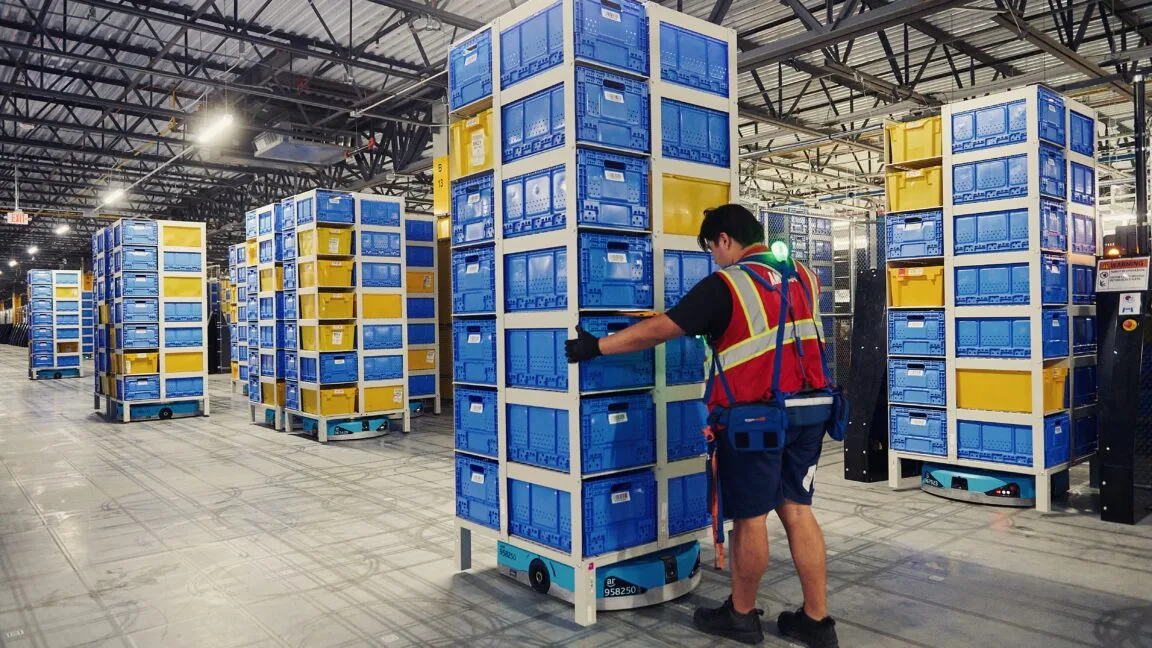
Hercules and Titan robots roam warehouse aisles to retrieve tall fabric shelving units. These units are called pods packed with plastic tote crates. Hercules and Titan robots are the size of a pool table or baby grand piano. They bring these pods to human employees at various workstations. Mobile robots typically follow grid lines of stickers laid out on the floor. They stay within fenced-in areas away from human employees.
The newest mobile robot, called Proteus, has sensors that allow it to operate safely around humans. Proteus can operate in a more free-roaming role than older models. Those swarms of mobile robots can sometimes create robotic traffic jams. Amazon began coordinating its robots using a suite of AI foundation models. This suite is collectively named DeepFleet. DeepFleet can help predict potential robot congestion ahead of time.
Amazon has been deploying a growing number of robotic arms. These arms can grab items stowed high up inside inventory pods. They sort packages and place them in carts or on top of mobile robots. They handle the many different individual products that Amazon customers order online. The company expects to more than double its existing fleet of robotic arms this year. Amazon CFO Brian Olsavsky stated this during a July earnings call.
When Ars sought clarification, Dresser described the current number of deployed robotic arms. He said the number was in the single-digit thousands. A robotic arm system called Cardinal uses a suction system to grab boxes. It stacks them inside a rolling cart. Amazon first bought third-party robotic arms to help lift and stack heavy pallets. These early arms helped with bins inside fulfillment centers.
The first robotic arm developed in-house by Amazon Robotics to work automatically. This new system allows the arm to function without direct human intervention. A model that answers well gets more traffic in the routing system. One that fails gets less traffic over time. A new model is just one catalogue entry in the system. It competes on the next request without changing the app.
This allows rapid experimentation with new robotic strategies. Teams can test different approaches quickly and safely. The hosted platform keeps a models catalogue with prices and rankings. These rankings are built from real traffic data. Teams see what works best in their specific environment.
OpenSmartRoute works with any OpenAI-compatible provider. It supports open-weight models served locally on-site. It integrates with MCP tools and A2A agents for complex workflows. An input guard spots prompt injection before a request leaves. This protects the physical robots from malicious inputs. The guard ensures only safe commands reach the hardware.
The savings ledger shows what each routed request cost. It compares the cost against the most expensive model option. Teams see exactly how much they save by using the router. This setup mirrors how Amazon coordinates its DeepFleet for robots. Both systems optimize for speed, safety, and efficiency at scale.
Start by defining the catalogue of robot skills and their limits. List every task the robots can perform and their success rates. Configure the scoring weights for quality, cost, speed, and safety. Adjust these based on your specific warehouse goals and constraints.
Set up hard rules for data privacy and regional restrictions. Ensure personal data never leaves the required secure environment. Deploy the input guard to block prompt injection and sensitive data. Test the guard with various inputs to ensure it catches threats.
Run the 'osr eval' tool to measure routing accuracy on your prompts. Fail a build if the evaluation score drops below your threshold. Monitor the savings ledger daily to track costs against the baseline. Look for patterns where certain robots consistently underperform.
Update the catalogue entries when new models or robots arrive. Add them to the catalogue so they can compete for traffic. Review the traffic distribution weekly to ensure models are working well. Shift traffic away from failing models automatically through the router.
Document all changes to the catalogue and scoring rules for future audits. Keep a log of why specific rules were set or changed. This process ensures your robotic fleet operates safely and efficiently. It scales as you add more robots and new tasks.
The doubling of the robotic arm fleet marks a significant step forward. It shows the company is investing heavily in automation. Human workers will continue to play a vital role in this process. The integration of AI and robotics creates new challenges and opportunities. Companies must adapt their strategies to manage these complex systems.
What to do when integrating new robotic systems
Start by defining the catalogue of robot skills and their limits. List every task the robots can perform and their success rates.
Configure the scoring weights for quality, cost, speed, and safety. Adjust these based on your specific warehouse goals and constraints.
Set up hard rules for data privacy and regional restrictions. Ensure personal data never leaves the required secure environment.
Deploy the input guard to block prompt injection and sensitive data. Test the guard with various inputs to ensure it catches threats.
Run the 'osr eval' tool to measure routing accuracy on your prompts. Fail a build if the evaluation score drops below your threshold.
Monitor the savings ledger daily to track costs against the baseline. Look for patterns where certain robots consistently underperform.
Update the catalogue entries when new models or robots arrive. Add them to the catalogue so they can compete for traffic.
Review the traffic distribution weekly to ensure models are working well. Shift traffic away from failing models automatically through the router.
Document all changes to the catalogue and scoring rules for future audits. Keep a log of why specific rules were set or changed.
This process ensures your robotic fleet operates safely and efficiently. It scales as you add more robots and new tasks.