Hi - I answer from the OpenSmartRoute documentation: routing, the API, plans and quotas, self-hosting. Ask away, or open a support ticket if you need a person.
Grounded in the docs - follow a source before acting on it.
Airline voice concierge uses Amazon Bedrock AgentCore and Nova Sonic - OpenSmartRoute
Airline voice concierge uses Amazon Bedrock AgentCore and Nova Sonic
AWS released a voice travel assistant for airlines using Amazon Bedrock AgentCore, Nova Sonic, and Managed Knowledge Bases.
Key points
Amazon Nova 2.5 Sonic handles speech-to-speech with low latency streaming.
The solution uses Strands Agents framework on the AgentCore runtime.
Model Context Protocol (MCP) connects the agent to backend tools via Gateway.
Amazon Bedrock Knowledge Bases grounds answers in airline policy documents.
Why it matters: You gain a scalable, secure voice layer that integrates with existing backend systems without tight coupling.
By OpenSmartRoute editorial · written through the router by writer-small
From AWS machine learning blog - “Build a voice travel concierge with Amazon Bedrock AgentCore, Managed Knowledge Base and Nova Sonic”
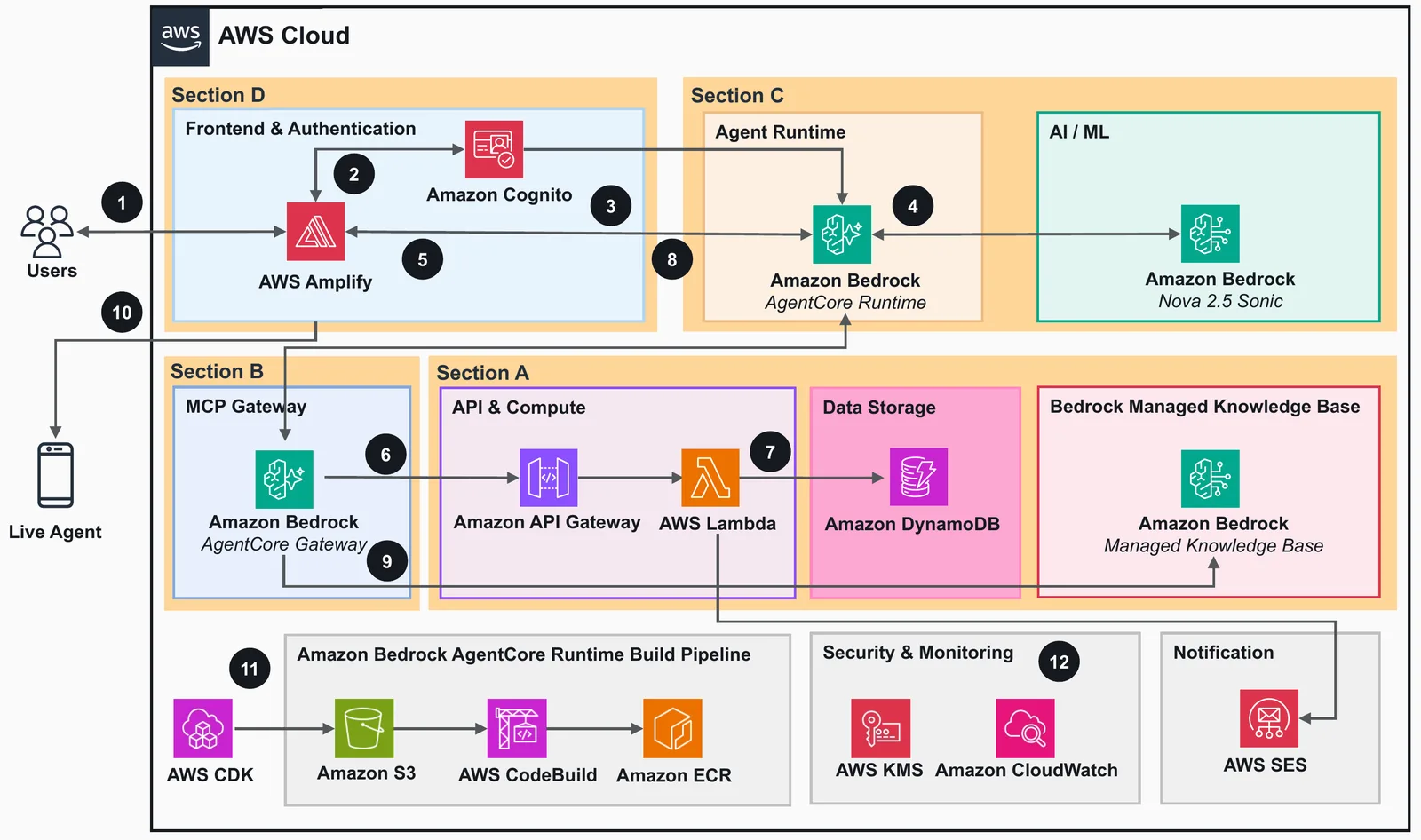
End-to-end voice concierge architecture spanning the backend, AgentCore Gateway, AgentCore runtime, and front end. Image: AWS machine learning blog (original)
Airlines now use a voice assistant built on Amazon Bedrock services. This new system lets travelers speak to change seats or check delays. The concierge runs inside existing airline apps without replacing the screens. Users can switch between typing and talking in the same session. Engineers deploy this using AWS Cloud Development Kit tools. The project splits into clear modules for easy reuse.
What was announced - A new architecture for airline voice concierges using specific AWS services
AWS released a guide to build a voice travel concierge. This system uses Amazon Bedrock AgentCore, Nova Sonic, and Managed Knowledge Bases. Airlines already have apps where people check flights and manage bookings. Adding a natural voice layer opens these tasks to spoken requests. A traveler can change a seat by speaking without leaving the app. They can also check for delays instantly.
Building this requires careful engineering on several fronts. You must stream audio in both directions constantly. The system holds the thread of a conversation across many turns. Engineers reach existing backend systems without tight coupling. It scales when traffic spikes before a holiday weekend. This architecture handles high volume efficiently.
The core components - Amazon Bedrock AgentCore, Nova Sonic, and Managed Knowledge Bases defined
Amazon Bedrock AgentCore is an agentic platform for building AI agents. It allows secure deployment at scale with your choice of framework. You can select the model that fits your needs best. Amazon Nova Sonic on Bedrock is a speech-to-speech model for real-time voice. It converts spoken input directly into spoken output quickly.
Amazon Bedrock Knowledge Bases is a fully managed retrieval augmented generation service. This grounds answers in your own documents for accuracy. A traveler speaks, and the concierge pulls up their itinerary. The system changes a seat or updates a meal preference. It answers policy questions and connects travelers to live agents.
Amazon Bedrock in AWS GovCloud now supports Claude Opus 5.5 and Claude Sonnet 5.5. These models hold FedRAMP Class D certification and DoD Impact Level 4 or 5 authorization.
Zhipu AI released GLM 5.3, a massive 753B-parameter model, on Amazon Bedrock today.
The architecture layers - Front end, AI agent, backend services separated into distinct sections
The architecture separates the front end, the AI agent, and backend services. These distinct layers let you develop and scale each one on its own. Model Context Protocol is an open standard for connecting AI applications to external tools. It carries standardized messages between the agent and the backend. This keeps the two systems loosely coupled together.
Separating these layers improves reliability during peak times. The front end handles user interaction directly. The AI agent processes requests and decides on actions. Backend services manage data and business logic securely. You can update one layer without breaking the others.
Backend infrastructure details - CDK stacks, DynamoDB, Lambda, API Gateway, and Cognito roles
The solution deploys using five specific AWS services for backend infrastructure. Amazon Cognito handles user authentication and temporary AWS credentials. It signs API access requests to ensure only authorized users act. Amazon Bedrock AgentCore runtime hosts the agent with microVM isolation per session. This keeps each traveler's conversation separate under heavy load.
Amazon Bedrock AgentCore Gateway exposes backend endpoints as discoverable MCP tools. It acts as a bridge between the AI and your internal systems. Amazon API Gateway publishes the backend as REST endpoints. AWS Identity and Access Management authorizes every single request. AWS Lambda runs the business logic for itineraries, seat maps, and flight status.
Amazon DynamoDB stores customer profiles, bookings, passengers, and seat maps. It handles purchase history and preferences with single-digit millisecond latency. Amazon Simple Email Service sends email notifications automatically. The backend scales on demand without manual intervention.
AgentCore runtime specifics - MicroVM isolation, Strands framework, and WebSocket support explained
Each session runs as a managed container on the AgentCore runtime. MicroVM isolation keeps travelers' conversations separate under heavy load. This prevents one user from interfering with another's data. AgentCore provides automatic scaling, built-in monitoring, and session routing. You do not need to manage the underlying infrastructure manually.
The agent uses the Strands BidiAgents framework to define system prompts. It sets the tools and conversation flow for the AI. Amazon Nova 2.5 Sonic brings capabilities for real-time speech processing. The runtime supports WebSocket connections for bidirectional audio streaming. This allows low latency communication between user and agent.
Knowledge Base integration - Retrieval Augmented Generation (RAG) for policy questions via MCP
Travelers ask about baggage limits, change fees, pet travel, and loyalty terms. The solution answers these using Retrieval Augmented Generation through Amazon Bedrock Knowledge Bases. It grounds responses in your airline policy documents for accuracy. You upload documents to Amazon S3 and create the knowledge base once. Amazon Bedrock handles embedding, chunking, indexing, storage, and retrieval automatically.
Storage runs on Amazon S3 Vectors, a capability of Amazon S3. Smart Parsing prepares source PDFs so tables retrieve accurately. When policy documents change, you sync the knowledge base immediately. There is no pipeline to redeploy the system. The agent discovers tools at runtime without custom code.
Nova Sonic capabilities - Speech recognition, reasoning, latency masking, and bidirectional streaming
Amazon Nova 2.5 Sonic brings strong reasoning for real-time voice concierges. It offers speech recognition across accents and robustness to background noise. Spoken responses adapt to the traveler's tone naturally. Bidirectional streaming with low latency keeps the conversation flowing. Asynchronous tool calling fetches data in parallel without pausing the chat.
Latency masking generates interim spoken responses while waiting for results. This keeps the conversation natural during processing delays. Audio streams from the front end as 16 kHz PCM over WebSocket. The model transcribes speech, picks tools, and calls them through MCP. It folds results into a spoken reply instantly.
Safety and responsible AI - Guardrails, confirm-before-write patterns, and grounding citations
For production deployments, add Amazon Bedrock Guardrails to filter prompt-injection attempts. This validates response grounding to ensure safety standards are met. The confirm-before-write pattern asks the traveler to confirm before making changes. It prevents accidental modifications to bookings or preferences. Knowledge base citations trace answers back to source documents. This provides a baseline of responsible AI practice.
The agent follows system prompts closely, including formatting rules. It reads confirmation codes and flight numbers one character at a time. Strong instruction following ensures the AI does not hallucinate facts. Accurate handling of responsible AI protects user data integrity.
How it compares - What existed before, what this changes and what stays the same
Old voice assistants used simple keyword matching. They could not understand natural language requests. Users had to say specific phrases to get results. This new system understands full sentences and context. It remembers the whole conversation history. The agent calls tools directly instead of searching a database manually.
Previous travel agents relied on rigid menu screens. Users tapped buttons to select options. This solution lets users speak their choices. They can change seats or check delays without touching the screen. The backend systems remain unchanged in structure. Only the interface layer now accepts voice commands. Developers do not need to rewrite core business logic.
The architecture uses managed services instead of self-hosted servers. AWS handles scaling and maintenance automatically. Teams focus on building features rather than infrastructure. This reduces operational overhead significantly. Security is built into every service component. MicroVM isolation protects each user session from others.
Existing chatbots often struggled with real-time audio. They had high latency or poor transcription quality. Nova Sonic processes speech instantly for voice responses. The system supports bidirectional audio streaming smoothly. Users hear answers while they are still speaking. This creates a natural conversation flow.
The previous approach required custom code for every tool. Developers wrote adapters for each backend service. AgentCore Gateway standardizes how tools connect to APIs. It uses the Model Context Protocol format universally. Teams can add new tools without changing the agent core.
Questions this leaves open - What the source does not say and how a reader can check it
The article mentions synthetic data but does not specify its volume or quality metrics. Readers should test the model with their own historical booking data to verify accuracy. They need to ensure the synthetic data covers edge cases like cancellations or delays.
There is no mention of specific pricing for Nova Sonic or AgentCore runtime usage. Teams must check AWS pricing calculator for costs per token and request volume. Hidden fees might appear in high-traffic scenarios during holiday weekends.
The text does not detail failover mechanisms if the voice service goes down. Readers should plan redundancy strategies for critical infrastructure components. What happens if the WebSocket connection drops mid-conversation? Does the system queue the audio or drop it entirely?
No specific latency numbers are provided beyond "single-digit milliseconds" claims. Independent benchmarks could measure actual round-trip times under load. Real-world performance might differ from synthetic test results in production environments.
The guide assumes access to Strands Agents framework without explaining licensing terms. Teams need to verify if their organization has the necessary commercial licenses. Open-source alternatives might lack some advanced features found in the managed service.
Security reviews are implied but not explicitly described in detail. Readers should audit IAM policies and Guardrail configurations for their specific use case. Custom prompt injection attacks could target the system differently than generic tests suggest.
The sample code is hosted on GitHub but no version numbers or update schedules are listed. Teams must check release notes to know when features change. Breaking changes might occur between minor versions of the CDK scripts.
Integration with legacy airline systems beyond DynamoDB and Lambda is not covered. Many airlines use older databases like Oracle or SQL Server. The MCP protocol might require additional adapters for non-AWS backends.
The article focuses on a single region deployment but does not address cross-region latency. Users in different geographic locations might experience slower response times. Network distance impacts audio streaming quality and processing speed significantly.
Evaluation metrics for the agent's decision-making accuracy are absent from the text. Teams should define success criteria like task completion rates or user satisfaction scores. Automated evaluation suites can measure hallucination rates against ground truth data.
The solution does not mention accessibility features for users with hearing impairments. Subtitles or visual cues might be needed alongside voice output for full compliance. Regulatory requirements vary by country regarding assistive technology integration.
What to do - Prerequisites, deployment steps, and sample data usage instructions
Before you begin, confirm that you have model access in Amazon Bedrock. You need Amazon Nova 2.5 Sonic in the AWS Region where you deploy. Check Supported models by AWS Region in Amazon Bedrock for availability. Amazon Bedrock Knowledge Bases uses a service-managed embedding model. You do not need separate embedding model access for this setup.
Install Node.js 20.x or later for AWS CDK and Lambda functions. Use Python 3.12 or later for data seeding and test clients. Configure the AWS Command Line Interface with your credentials. Install AWS CDK CLI globally using npm install -g aws-cdk. Bootstrapped your account with npx cdk bootstrap commands. Clone the accompanying code from the aws-samples GitHub repository.
The solution deploys with a single CDK script. Upload the agent source to Amazon S3 and trigger AWS CodeBuild. This produces the container image stored in Amazon ECR for runtime. Run the deployment script after configuring your AWS credentials. See the README in the GitHub repository for detailed steps.
API Gateway publishes REST APIs with IAM-authorized endpoints. Lambda integration works with DynamoDB tables for fast data access. The sample data model covers customer profiles, bookings, and flight status. It supports single-digit millisecond latency and on-demand scaling. You can adapt this pattern to your own backend systems easily.